Introduction
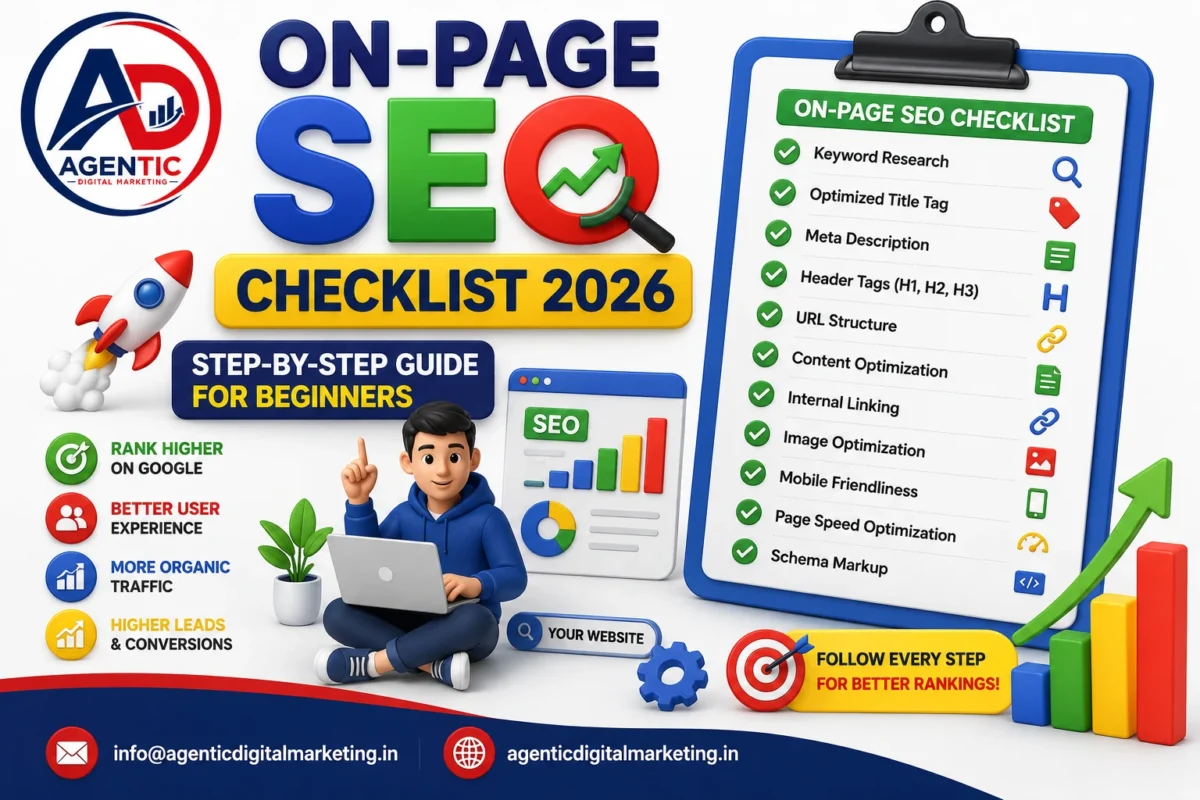
On-Page SEO Checklist 2026 – On-page SEO is one of the most controllable parts of search engine optimization — unlike backlinks or domain authority, it’s entirely within your hands. Yet many websites still miss basic fundamentals that prevent them from ranking well.
This 2026 checklist walks through every essential on-page SEO element, from title tags to internal linking, so you can audit and optimize your own pages step by step.
1. Title Tags
Your title tag is one of the strongest on-page ranking signals and the first thing users see in search results.
Best practices:
- Keep it under 60 characters
- Include your primary keyword near the beginning
- Make it compelling enough to earn clicks
- Avoid duplicate title tags across pages
Example: “Best SEO Company in Surat | Local & National SEO Services”
2. Meta Descriptions
While not a direct ranking factor, meta descriptions influence click-through rates significantly.
Best practices:
- Keep it between 150–160 characters
- Include the primary keyword naturally
- Add a clear call-to-action
- Make each page’s description unique
3. Heading Structure (H1–H6)
A clear heading hierarchy helps both users and search engines understand your content structure.
Best practices:
- Use only one H1 per page (usually the page title)
- Use H2s for main sections, H3s for subsections
- Include keywords naturally in headings — avoid stuffing
- Keep headings descriptive, not generic (“Benefits” vs “Benefits of Local SEO for Surat Businesses”)
4. URL Structure
Clean, descriptive URLs are easier for users and search engines to understand.
Best practices:
- Keep URLs short and readable
- Include the primary keyword
- Use hyphens to separate words
- Avoid unnecessary parameters, dates, or numbers
Example: /website-development-company-vesu-surat/ rather than /page?id=1234
5. Keyword Placement & Density
Modern SEO favors natural language over keyword stuffing, but strategic placement still matters.
Best practices:
- Include primary keyword in the first 100 words
- Use variations and related terms (LSI keywords) throughout
- Maintain natural readability — write for humans first
- Avoid repeating the exact keyword excessively
6. Content Quality & Length
Search engines favor comprehensive, well-structured content that thoroughly answers user intent.
Best practices:
- Match content length to search intent (don’t pad unnecessarily)
- Cover the topic thoroughly with subtopics and FAQs
- Update content regularly to keep it accurate
- Use bullet points, tables, and visuals to improve readability
7. Internal Linking
Internal links help distribute authority across your site and guide users to relevant pages.
Best practices:
- Link to relevant service or location pages using descriptive anchor text
- Avoid generic anchors like “click here”
- Don’t overdo it — 2–5 contextual internal links per page is reasonable
- Ensure linked pages are actually relevant to the content
For example, a blog post about local SEO strategy naturally links to a local SEO services page, while a post about website performance might link to a website development company page.
8. Image SEO
Images affect both SEO and page speed.
Best practices:
- Use descriptive file names (e.g.,
local-seo-checklist-2026.webp) - Add descriptive alt text including relevant keywords naturally
- Compress images (WebP format recommended)
- Use appropriate dimensions — avoid oversized images
9. Schema Markup (Structured Data)
Schema helps search engines understand your content better and can enable rich results.
Common schema types:
- FAQ schema for Q&A sections
- LocalBusiness schema for location-based businesses
- Breadcrumb schema for navigation
- Article schema for blog posts
10. Mobile-Friendliness & Page Speed
With mobile-first indexing, your site’s mobile experience directly impacts rankings.
Best practices:
- Ensure responsive design across all devices
- Compress images and minimize code
- Use caching and a content delivery network (CDN)
- Test using Google’s PageSpeed Insights regularly
On-Page SEO Quick Checklist
- Unique, optimized title tag
- Compelling meta description
- Single H1, logical heading structure
- Clean, keyword-rich URL
- Natural keyword placement
- Comprehensive, well-organized content
- 2–5 relevant internal links
- Optimized images with alt text
- Relevant schema markup
- Mobile-friendly, fast-loading page
Frequently Asked Questions: On-Page SEO Checklist 2026
Q: What is on-page SEO?
A: On-page SEO refers to all the optimizations made directly on a webpage — including title tags, headings, content, internal links, and images — to improve its search engine rankings.
Q: How is on-page SEO different from off-page SEO?
A: On-page SEO involves elements you control directly on your website, while off-page SEO refers to external factors like backlinks and brand mentions.
Q: How many internal links should a blog post have?
A: A general guideline is 2–5 contextual internal links per post, pointing to genuinely relevant pages.
Q: Does keyword density still matter in 2026?
A: Not in the traditional sense. Modern search engines focus on relevance and natural language rather than exact keyword density percentages.
Q: How often should I update on-page SEO elements?
A: Review key pages every few months, especially for outdated information, broken links, or opportunities to improve content based on performance data.
Final Thoughts
On-page SEO forms the foundation of any successful search strategy. While off-page factors like backlinks matter, a well-optimized page structure ensures search engines can properly crawl, understand, and rank your content — and that visitors find what they’re looking for once they arrive.
🚀 Ready to Grow Your Business Online?
